Special Education

Know what a fair rate is before the agency contracts renew.

The Assistant reads your master contracts and rate sheets, compares each position with districts your size and writes the explanation your cabinet will ask for.

In special education, a few agency contracts carry a large share of the budget, and every number in them gets questioned. The Assistant reads the agreements, rate sheets and invoices, compares them with districts your size and gives you the reason behind each figure before cabinet asks for it.

The work

Rates, agreements and the reasons behind them.

Ask about a position, an agency or a year in your own words. It reads the agreements, does the math and links each figure to the page it came from.

Compares each position’s rate with districts your size.

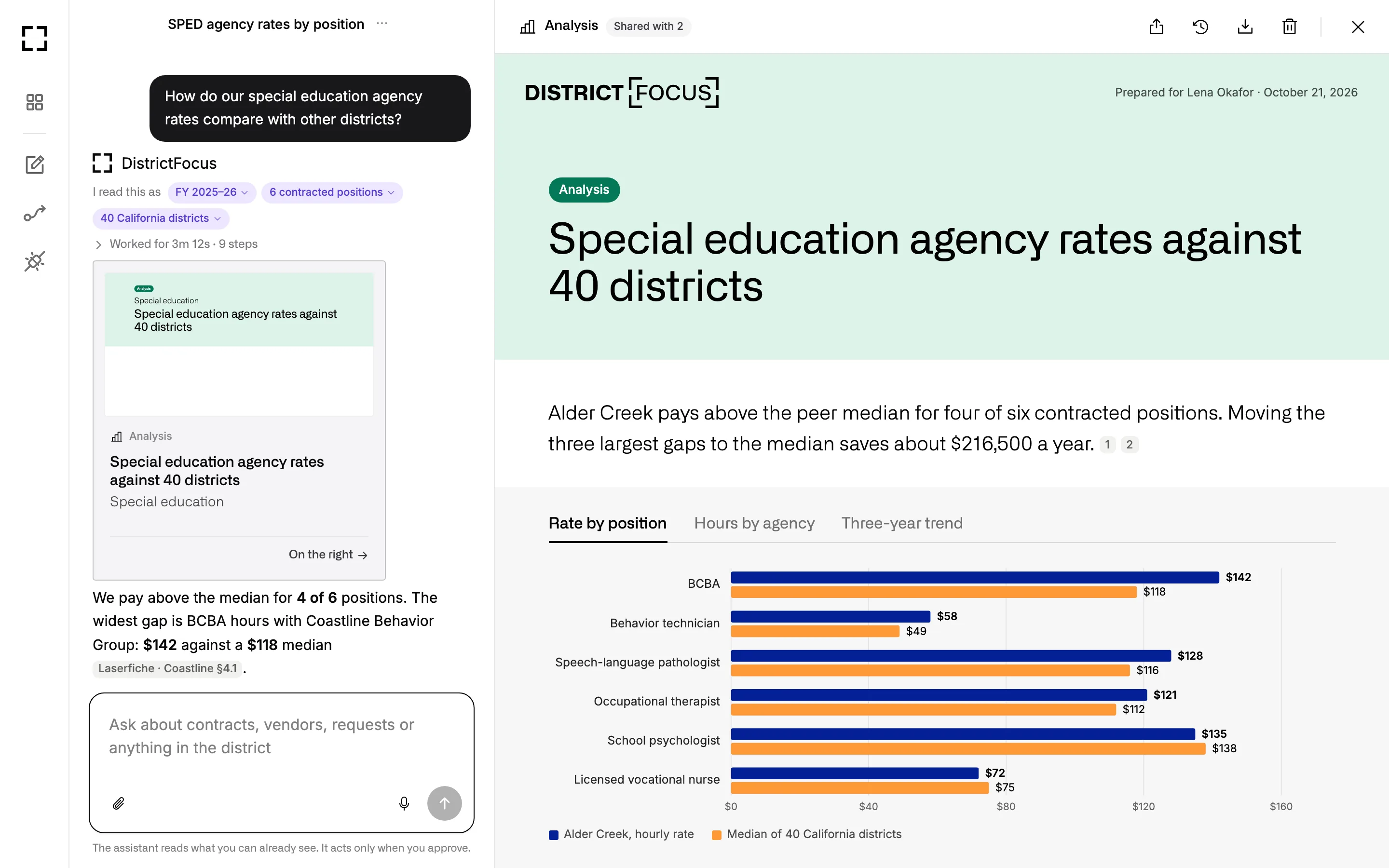
Speech, occupational therapy, behavior, school psychology, nursing: it lines up your hourly rate for each contracted position against the median of similar districts, with the agreement and page behind every rate.

Try asking

Compare our SLP, OT, BCBA and nurse rates with districts our size, by vendor.

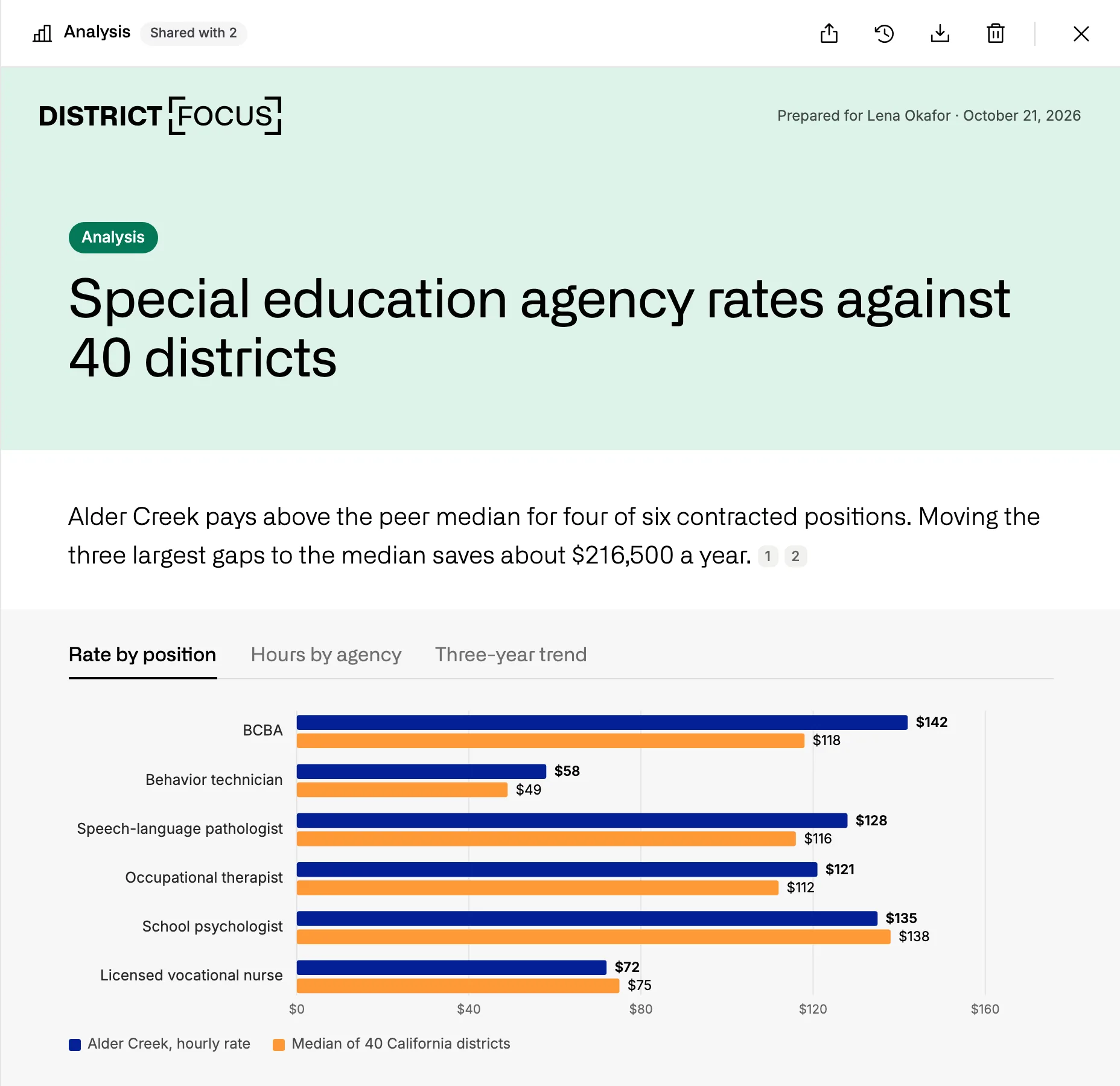
An analysis titled Special education agency rates against 40 districts, with a bar chart of Alder Creek’s hourly rate for each position beside the peer median.

Shows what changed on next year’s rate sheet.

When an agency sends a new sheet, it sets each position’s rate beside last year’s and the county median, so you can see which increases go past what similar districts pay before you sign.

Try asking

This agency sent next year’s rate sheet. What changed for each position, and how does it compare with our county?

An agency’s 2027–28 rate sheet compared with 2026–27, position by position, against the county median, with sources to both sheets.

Reads every agreement and rate sheet you hold.

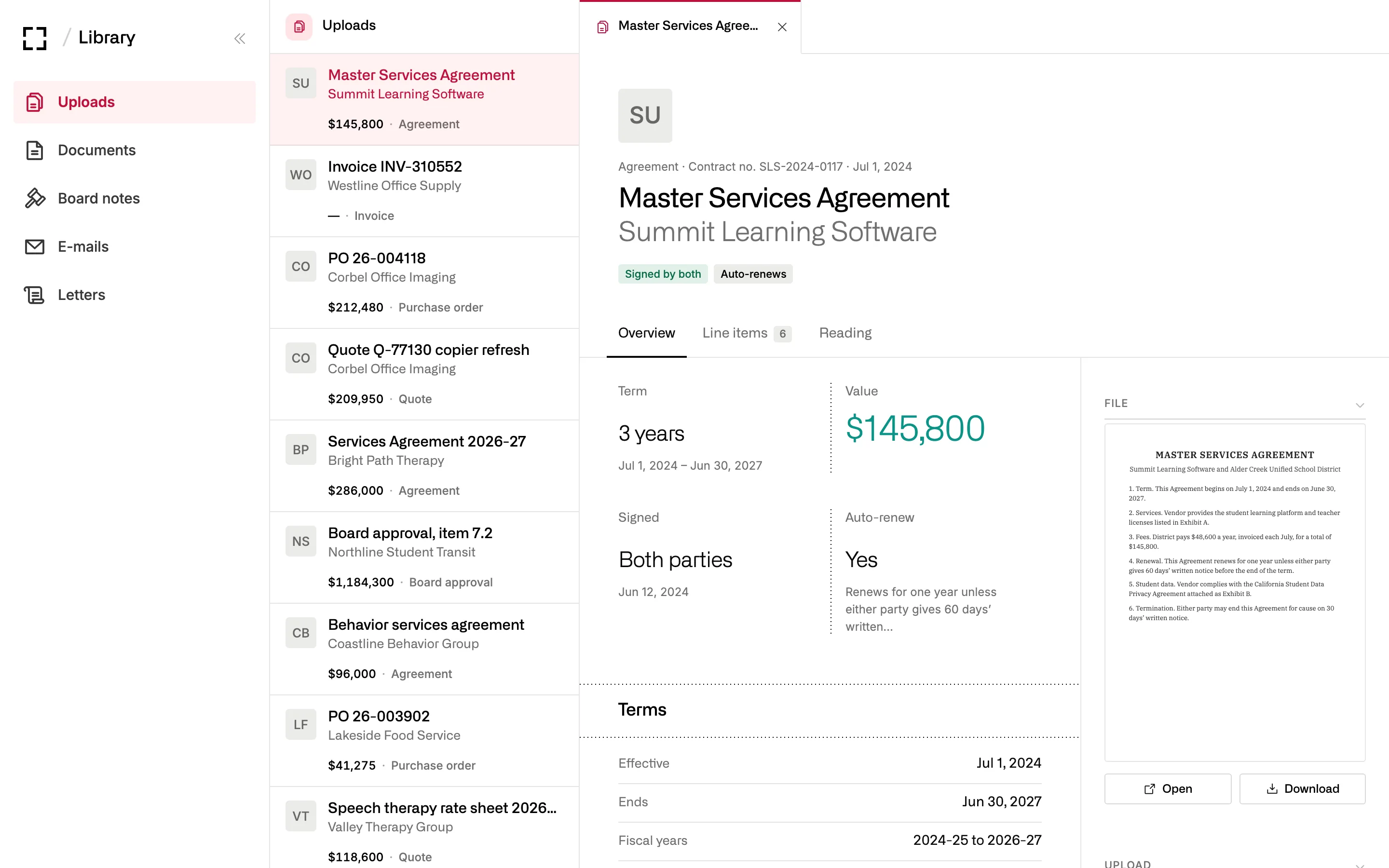
Master contracts, rate sheets, amendments and invoices are read and labeled as they arrive, with each cap, term and renewal date pulled out. If you inherited the department, you can see what it holds.

Try asking

I’m new in this role. What agreements do we hold, what does each cap, and what renews before June?

Uploads in the Library, including agency service agreements and a rate sheet, with one master services agreement open: term, value, signatures and auto-renewal.

Writes the explanation cabinet asks for.

It separates rate from hours from the number of placements, so the brief says what drove the change this year, with sources your cabinet can open.

Try asking

The cabinet asks why special education staffing costs more this year. Draft the brief with sources.

Lena Okafor’s request in the chat, the steps the Assistant took and the finished analysis open beside it.

Finds what districts like yours pay and do.

It reads public FCMAT reviews, board packets and bid awards to show how similar districts staff a program and what they pay for it, with a source on every row.

Try asking

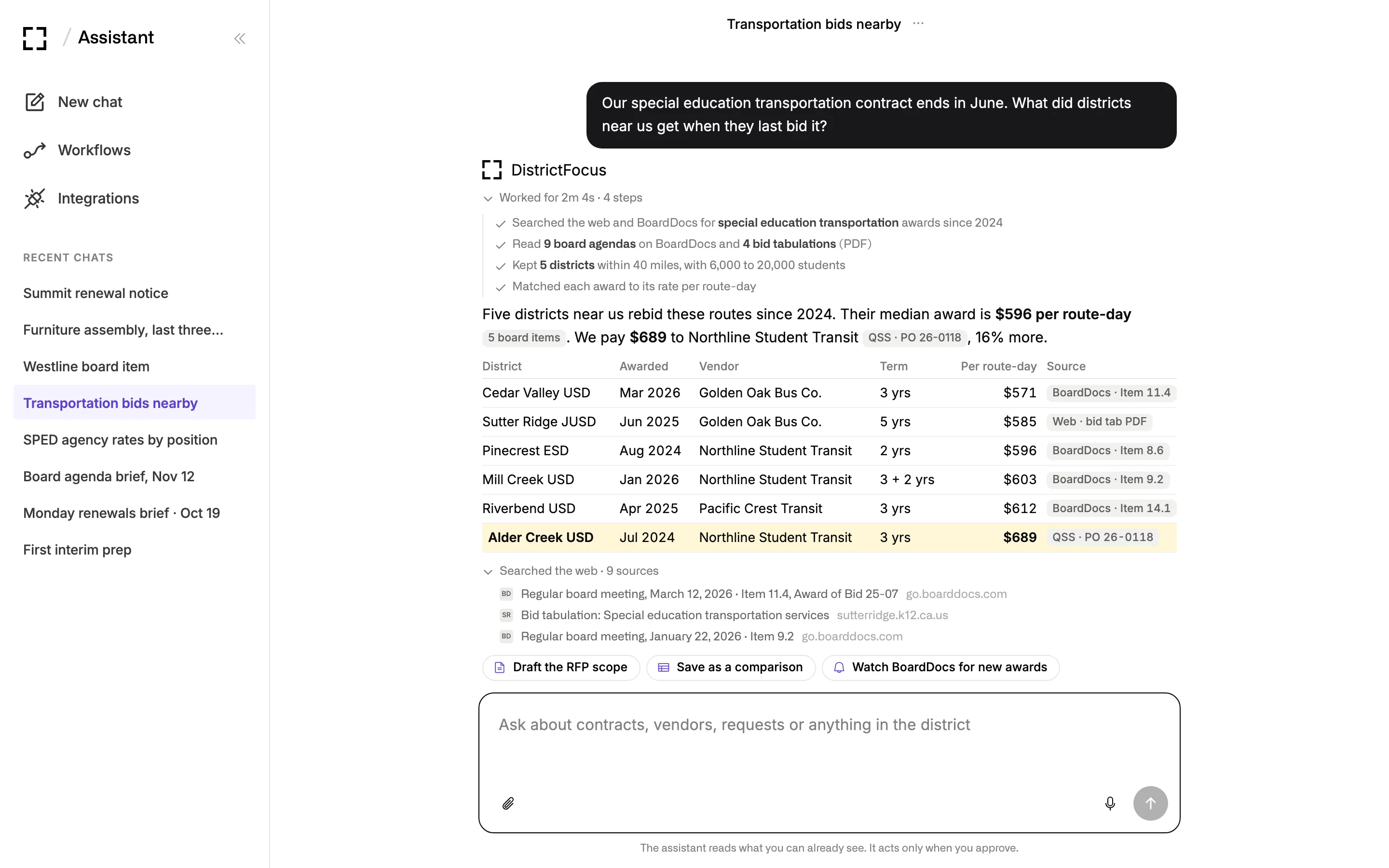
What do districts our size do for behavior services? Use public FCMAT reviews and board packets.

Research across board agendas and bid tabulations: special education transportation awards in five nearby districts, each row with its source.

Standing work

It keeps the numbers current and drafts the follow-up.

Saved analyses run again when new data arrives, so the version you bring to cabinet in May reflects the rates you hold in May, and the letter that follows is ready to edit.

Workflows

Runs the rate comparison again when a new sheet arrives.

Set a run rule once. When a new rate sheet, invoice file or PO export comes in, the comparison runs again and anything that changed lands on your Home page.

Try asking

Re-run our agency rate comparison whenever a new rate sheet comes in.

Special education workflows: agency rates against peers each month, new rate sheets every Friday, next year’s NPA board item every May and invoices against contract rates, with one workflow’s run rule and last runs open.

Letters

Asks an agency to match, in writing.

When a rate moves past the county median, it drafts the letter on your letterhead, citing the rate review clause in your agreement. You edit it and send it yourself.

Try asking

Draft a letter asking this agency to match the median rate in our county.

A drafted letter on district letterhead asking an agency to hold its BCBA rate at the county median under the rate review clause, open beside the chat.

Memory

Knows who owns which agreement.

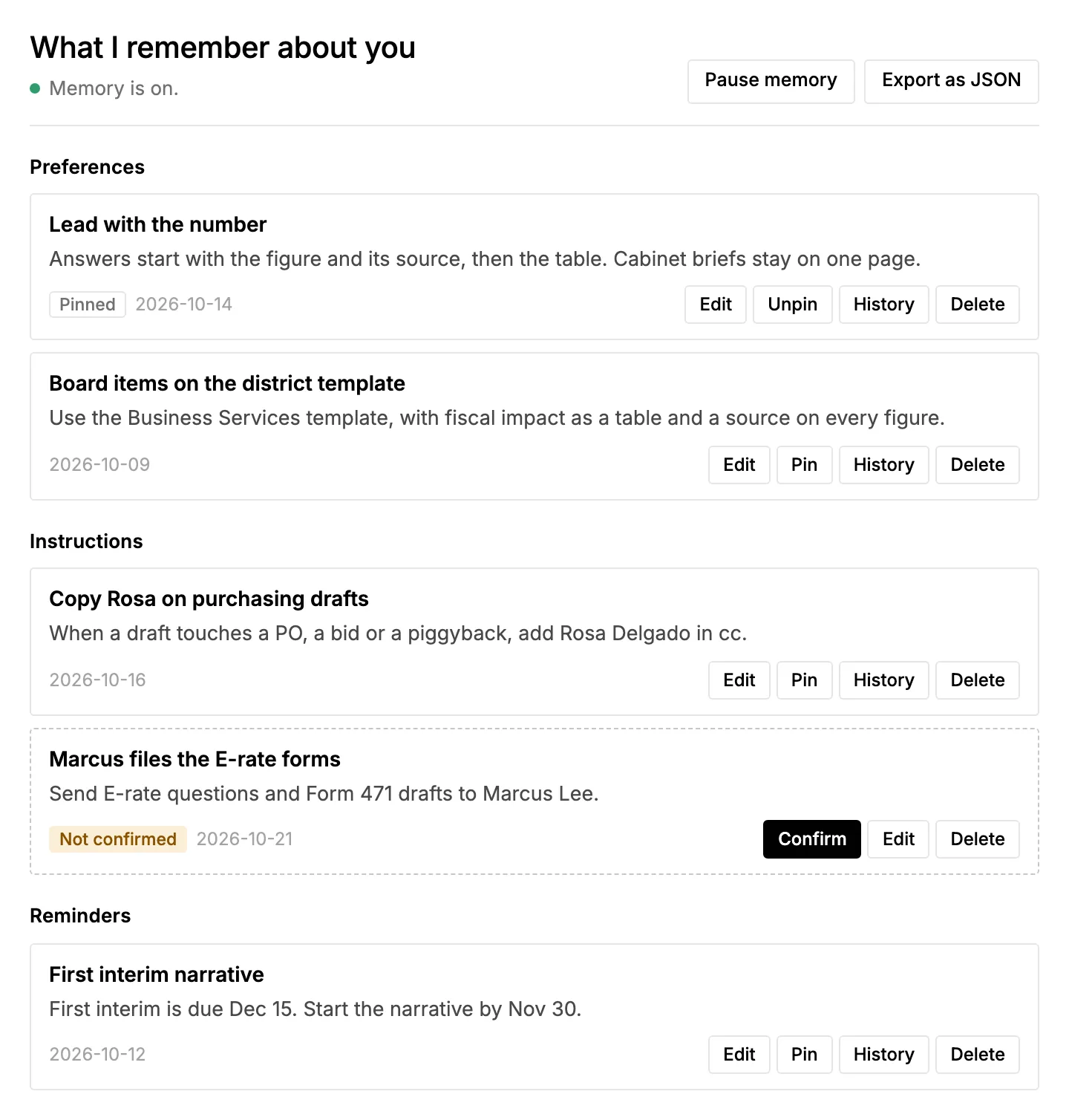
It keeps short notes as you work: which agency covers which positions, who signs off, what cabinet asked for last time. You can read and change every note, and it won’t keep a note about a student.

Memory notes about how the person works, each with Edit, Pin, History and Delete, and controls to pause memory or export it.

Your year

From extended school year to the May board items.

Tie routines to the California dates your department already plans around, and the analysis is waiting before each one.

  1. All year Coming up

    IEP meetings, assessments, compensatory services and due process.

    What the Assistant hands you: This work stays with your team. The Assistant’s special education work runs on contracts and costs.

  2. Jul to Aug Coming up

    Extended school year runs, and NPS and NPA master contracts start on fiscal-year terms.

    What the Assistant hands you: The agreements that start July 1, with rates by position and caps.

  3. Sep Coming up

    Caseloads are assigned and agencies fill the open positions.

    What the Assistant hands you: Agency cost against in-house cost for each open position.

  4. Early Oct Coming up

    Census Day sets total enrollment for the year.

    What the Assistant hands you: Special education enrollment set against total enrollment, over five years.

  5. Dec 15 Coming up

    First interim report, where the general fund’s contribution to special education shows.

    Ed Code 42130

    What the Assistant hands you: Spending this year against last, by agency, with what drove the change.

  6. Spring Coming up

    Agencies and the county send rate sheets for next year.

    What the Assistant hands you: What changed for each position, set against your county and similar districts.

  7. May Coming up

    Board items for next year’s agency and NPA contracts.

    What the Assistant hands you: The board item, with rates against similar districts and the fiscal impact.

  8. Jun Coming up

    Program and staffing decisions for next year, before the budget is adopted.

    What the Assistant hands you: Options for cabinet, with the cost of each.

Try asking

Ask the way you’d ask a fiscal analyst, if you had one.

These are requests a special education director might hand it. Each one runs on agreements, rates and spending.

  • Rates

    Compare our SLP, OT, BCBA and nurse rates with districts our size, by vendor.

  • Rate sheets

    This agency sent next year’s rate sheet. What changed for each position, and how does it compare with our county?

  • Agencies

    We buy the same positions from two agencies. Which one should get each position, based on the rates we already hold?

  • Spending

    Show our agency and NPA spend this year against last year. Was it the rate, the hours or the number of placements?

  • Cabinet

    The cabinet asks why special education staffing costs more this year. Draft the brief with sources.

  • Staffing

    What would it cost to hire three teachers with benefits instead of these eight agency positions?

  • Letter

    Draft a letter asking this agency to match the median rate in our county.

  • Board

    Draft the board item for next year’s agency and NPA contracts, with the fiscal impact.

  • Research

    What do districts our size do for behavior services? Use public FCMAT reviews and board packets.

  • New in the role

    I’m new in this role. What agreements do we hold, what does each cap, and what renews before June?
Systems

It works from the files you already keep.

It works from your shared folders of agreements and rate sheets, finance exports for spending, board packets and public state data.

  • Google Drive Agreements
  • SharePoint Agreements
  • OneDrive Rate sheets
  • Laserfiche Contract files
  • Excel Trackers
  • Outlook Rate letters
  • Gmail Rate letters
  • County finance (QSS) PO and AP reports
  • BoardDocs Board packets
  • CDE Public data
  • FCMAT reports Public reviews
  • The web Peer board packets

There’s no connection to your IEP system. Special education work in District Focus runs on agreements, rate sheets, invoices and public data.

Privacy and security

How student information is handled.

  • Contract and spending work doesn’t run on student records. Some files you send do name a student, such as a special education service agreement. Those files stay in your district’s space.
  • The Assistant won’t keep a memory about a student, a parent or a guardian. Each note is checked before it’s saved, and a note that names a student is refused.
  • We don’t train AI models on your data.

Bring next year’s rate sheet.

We’ll show you the Assistant comparing that kind of sheet with districts your size, and walk you through how files that name a student are handled.